The metrics that prove legal value, and the ones that waste everyone’s time.
The CFO walks into your office. What is Legal doing? Are we staffed right? Are we getting value? You have got thirty seconds to give an answer before the conversation disappears and you are left scrambling.
That is where KPIs come in. The right metrics answer the question directly. The wrong metrics make you sound like you are hiding something. So let me give you the framework for knowing the difference.
The reason most Legal Departments struggle with KPIs is that we default to what is easy to measure, not what is worth measuring. Hours logged looks precise until someone asks why it matters. Emails answered feels productive until you realize your team spent all day on noise and nothing on work that matters.
Good legal metrics connect work to business outcomes. They show what you are doing, how efficiently you are doing it, and what it costs.
KPIs That Matter
Matter Volume and Throughput. How many legal matters does your department handle per month? How many closed? These numbers matter because they show work volume and capacity. If you are handling one hundred matters and closing two, you have a serious problem. Matter throughput tells you whether you are keeping up with demand or drowning.
Track this by type. Vendor agreements, employment, litigation, IP, real estate, contracts. The distribution matters because it tells you where your team is spending time and where you might be understaffed. It also helps to add depth to your conversation with the CFO about the metric: Our throughput has increased 23% primarily driven by an increase in sales contracts (see how that will keep CFO happy!?) but we are going to need a new hire to keep up with the demand (business case achieved).
Turnaround Time by Matter Type. This is the big one. How long does it take to resolve a standard vendor agreement? A typical employment issue? A routine contract review? These turnaround times are your operational efficiency metric. If you are taking sixty days to close a vendor NDA that should take five, something is broken.
Comparing your turnaround times to benchmarks (or to your own historical data) tells you where you need to improve. Maybe you need to automate something or introduce AI for a component of the task. Maybe you need more people. Maybe you need better intake so you are not starting work with missing information. Note that any blocker to business goals and efficiency will be a focus point for your CFO, so demonstrating that you know where they are – and proactively looking for solutions to fix them – will be met with support.
Outside Counsel Spend vs. Budget. This is the metric that gets CFO attention immediately. Are you on budget? Are you spending what you said you would spend? Month to month, are you trending over or under? And which firms are consuming most of your budget?
This metric matters because it is tied to financial impact. Overrun here, and you are explaining to finance why you need more budget. Control it, and you are a hero.
Work Distribution. Who is doing what? How is work distributed across your team? Are some people overloaded while others are coasting? This metric tells you about resource utilization and workload balance.
Healthy work distribution means people are engaged and productive. Unbalanced distribution means you are inefficient and burning out your best people.
Aging Matters. How many matters are currently in progress? How long have they been sitting? Aging matters are the legal equivalent of dead inventory. Every matter that is open for six months without progress is a problem.
Track aging by bucket: zero to thirty days, thirty to sixty days, sixty to ninety days, ninety plus days. A matter sitting for six months with no movement means it is blocked, forgotten, or stalled. You need to fix whatever the issue is.
KPIs That Waste Time
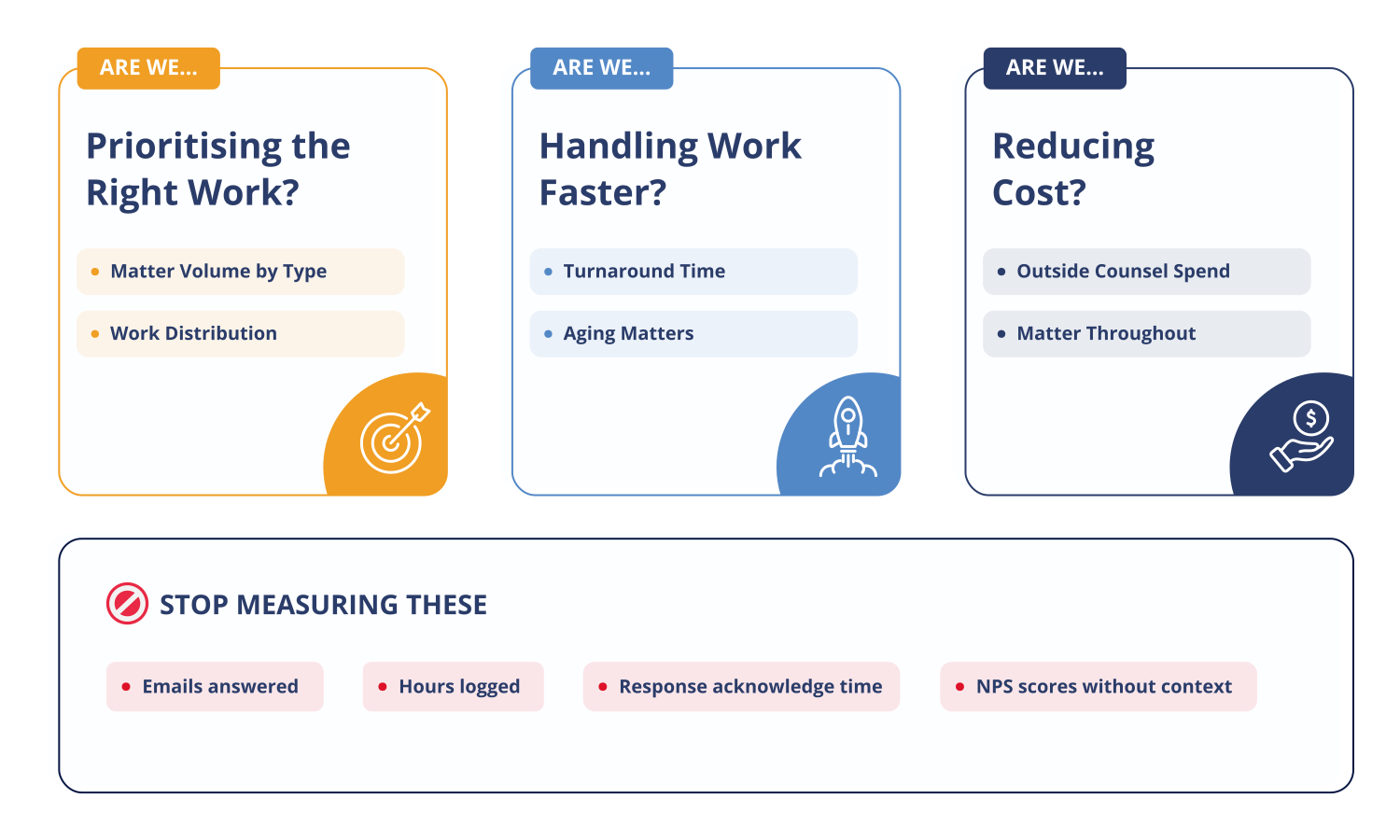
Emails Answered. I see this one constantly. Someone argues that tracking emails answered proves your team is responsive. No, it proves your team gets emails. It proves nothing about whether those emails matter or whether the answers solve the problem. Stop measuring this.
Hours Logged Without Context. This is the law firm mentality. If everyone worked forty billable hours, the company is profitable. But hours logged in a corporate legal department tell you almost nothing. You are not trying to maximize billing. You are trying to maximize output. If your team closes a matter in five hours instead of twenty, that is a win, not a loss.
Focus on turnaround time and throughput instead of hours. That measures what matters.
Customer Satisfaction Scores Without Nuance. Asking people if they are satisfied is fine. Using a numerical score as your primary KPI is useless. Satisfaction scores are easy to game, hard to interpret, and don't correlate to anything business relevant.
Get feedback. Talk to the business regularly. But don't use Net Promoter Score as your main metric for legal effectiveness.
Request Response Time Without Context. We respond to legal requests in two hours. Sounds great. But what if the request is a simple email that needs a one-line answer? That response time is artificial. And what if the request is a complex merger question that deserves careful analysis? Two hours is irresponsible.
Measure response to urgent requests separately from routine requests. Then measure actual resolution time, not just acknowledgment time.
Connecting KPIs to Business Outcomes
Here is the framework. Every KPI should answer one of three questions: Are we prioritizing the right work? Are we handling work faster? Are we reducing cost?
Matter volume tells you if you are handling more work, but it requires the nuance of work type to really hit a home run*. Turnaround time tells you if you are handling it faster. Outside counsel spend tells you if you are reducing cost. Work distribution tells you if people are engaged. Aging matters tells you if we are stuck.
Everything else is noise. If a metric doesn't connect to one of those outcomes, you are measuring something that doesn't matter.
* Side note: Xakia clients take this one step further and capture information about the strategic impact of work being done. Using a carefully built scaling system, this metric allows you to have impactful conversations about appropriate prioritization of work, its turnaround time and cost.
Building Your KPI Dashboard
Let us talk practically about how to build this. You don't need anything fancy. A simple spreadsheet with manual data entry works if you keep it simple. A better approach is a matter management system that captures this data automatically.
Either way, your dashboard should show this: Last month matter volume. Current matters in progress. Average cycle time by matter type. Current external counsel spend versus budget. Work distribution by person or team.
Update it monthly. Review it in a team meeting. Share it with leadership. Make it boringly repetitive. That is the goal: Boring metrics mean everybody understands what they mean, and you can drive toward clear goals with consistent performance.
The Maturity Curve
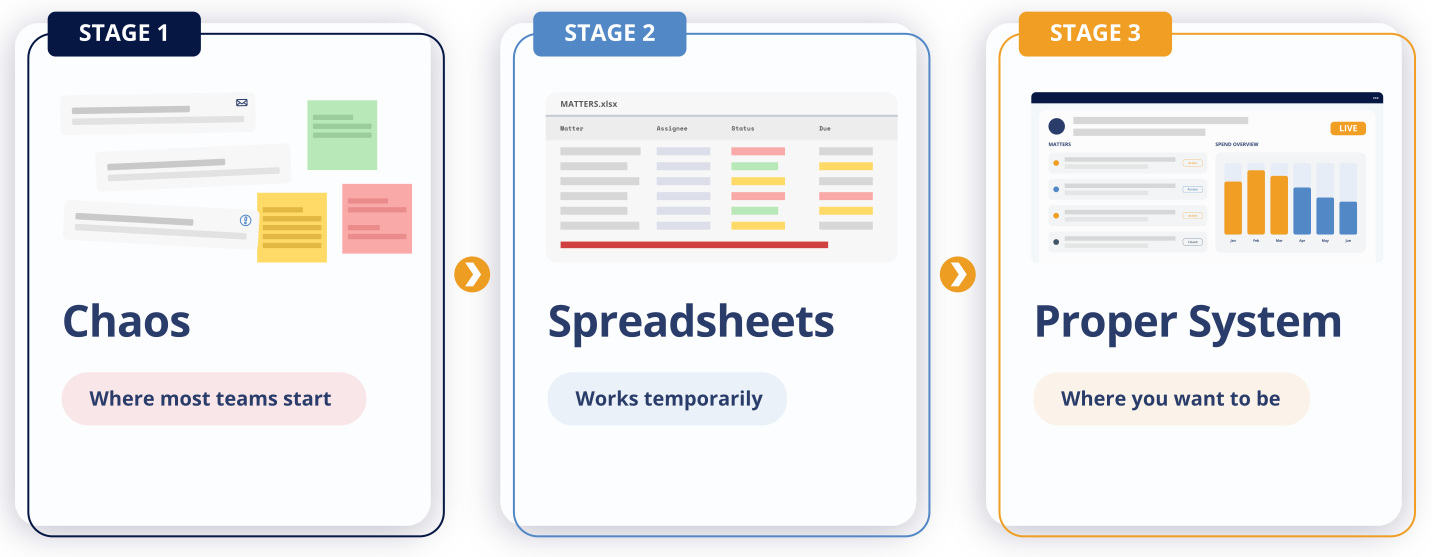
Most Legal Departments do not start with data discipline. They start with chaos. Then they realize they need visibility and patch together spreadsheets. That works temporarily. Then they realize spreadsheets do not scale and invest in proper systems.
The forward-thinking teams skip the middle step. They invest in systems early and are able to achieve good data from day one. Then they can measure their impact from the beginning.
This matters because it changes the conversation with leadership. Instead of “we need another hire” you can say “our throughput per person is X, our average turnaround time is Y, and adding one person will increase capacity by Z percent.” Data makes the business case for you.
KPIs by Situation
If You Are Growing Fast. Your priority is understanding capacity. Track matter volume, turnaround time, and work distribution. You need to know when to hire before you are drowning.
If You Are Cost-Focused. Your priority is outside counsel spend. Track spend versus budget, spend by vendor, and spend by matter type. Know where your money goes.
If You Are an Established In-House Counsel. Your priority is probably a mix. You care about throughput because you have limited resources. You care about turnaround time because the business expects responsiveness. You care about outside counsel spend because it comes out of your budget.
If You Are Managing a Team of Teams. Your priority is visibility and consistency. You need to see work distribution across teams. You need to identify bottlenecks and resource imbalances.
Start with KPIs that matter to your situation, not all of them. You will add more as you mature.
Common KPI Mistakes
Mistake One: Too Many Metrics. You measure twenty things. Nothing is clear. Everything requires explanation. Focus on five, maximum.
Mistake Two: Metrics Without Context. Your matter volume went up by 20% last month. Is that good? Bad? Depends on whether you hired, whether it is seasonal, whether you changed scope. Always provide context. Use a system that allows you to add commentary to your dashboards.
Mistake Three: No Benchmarking. You have no idea if your cycle times are reasonable. Your spend might be high or low. You need comparison points. Track your own data over time. Compare to peer organizations if you can.
Mistake Four: Incentivizing the Wrong Behavior. If you track hours logged, people will log hours instead of solving problems. If you track number of matters closed, people will close easy matters instead of important ones. Make sure your metrics incentivize behavior you want.
The Technology Reality
Here is the uncomfortable truth. You can't track good KPIs with email and spreadsheets. You need a system that automatically captures matter creation, completion, time, and cost. You need reporting that requires two clicks, not two days of Excel work.
If you are manually compiling data for your KPI reports, you are wasting time that could go to work. And your data is probably wrong. Get a system that does the tracking for you.
How to Start Tracking
Don't try to measure everything, pick three metrics: Matter volume. Turnaround time. Outside counsel spend. Get those right and get them into a report. Review them monthly and then once you have got those working, add more.
Start with data you already have or can easily get. You probably know how many matters you close per month. You probably know roughly how long certain matters take. You probably have invoices from outside counsel. Build from there.
Then, once the basics are in place, invest in a system that captures everything automatically. You will spend a weekend setting it up – it should not take longer than this to get started in any modern system. You will save hours every month in reporting work.
The Research Insight
Here is something important: 64% of small legal departments recognize the value of a technology roadmap but don't have one. That research tells me most legal teams aren't tracking their metrics systematically.
They are flying blind. That is why they can't answer the CFO question.
If you get this part right, you will stand out immediately because you will have data and you will know your numbers. You will be able to make informed data-driven decisions instead of guesses.
Making the Ask
When the board or the CFO asks what Legal is doing, you say this: We handled X matters this month, up from Y last quarter. Our average turnaround time for routine agreements is fifteen days, which is steady. We are on budget for outside counsel spend at 85% of annual budget with three months remaining. Our team is at healthy utilization levels.
That answers the question completely. You look like you know what you are doing, because you do.
That conversation is different from scrambling for an answer. The difference is data. The difference is discipline.
If you are not tracking these metrics right now, start this month. Pick the three most important ones for your situation. Set up a basic report. Review it monthly. You will be amazed at how much clearer your work becomes and how much easier leadership conversations become.
Want to see how the right system makes KPI tracking automatic and painless?
Book a free demo at xakiatech.com/book-a-demo to see matter management with built-in reporting.