The Best Legal Matter Management Software 2026: Our Team’s Honest Opinion
Legal matter management software is where an in-house team runs every matter from intake to close: the work, the deadlines, the documents, and the spend, all in one place instead of scattered across email and spreadsheets. We built Xakia so a team can be up and running in days, not months, with reporting that shows leadership what the Legal Department is doing
Modern in-house lawyers are dealing with heavy workloads under significant resource strain. Legal Departments are often dealing with a stack of disorganized legal requests, worsened by a lack of visibility across active matters. In this context, the right matter management platform can be an eminently useful salve to your team’s organizational woes.
The right system improves transparency, reduces administrative effort, and helps legal teams make informed, strategic decisions. Drawing on our experience partnering with hundreds of in-house teams globally, and our deep understanding of legal operations and technology, we break down what the best solutions in 2026 truly offer.
With a large variety of competitors in the relatively new field of matter management software, it can be difficult to choose which is the best fit for your business. The wrong software can lead to bad data, integration issues and low adoption internally. Choosing the right software can transform how your team operates.
In this article we will survey the growing field of Legal matter management software, delving specifically into different options to give you our recommendation for the best in the business.
What is matter management software and why is choosing the right software so important for your business?
Put simply, legal matter management software provides a centralized, structured system for organizing all legal work within an organization. Rather than relying on scattered email chains, spreadsheets, or ad-hoc processes, it brings matters, documents, deadlines, spend and communications into one streamlined platform.
Centralized Visibility for All Legal Work
Matter management software gives in-house legal teams a unified view of every active and historical matter, allowing them to monitor progress, track deadlines, control spend and identify risks early. This is the classic case of improving visibility to ensure everybody understands who is working on what, and to bring your Legal Team's collective blood pressure down.
By automating intake and document assembly, organizing information, and reducing manual updates, Legal Teams can spend more time on high‑value legal work rather than operational tasks. A simple, clear process for receiving, reviewing and assigning work, ensuring the first few steps automated, and offering up self-help tools to your business will reduce your Legal Team's admin workload by at least 40%.
Better Reporting, Data Quality & Stakeholder Communication
Strong matter management tools deliver accurate data, enabling you to report on workload, risk trends, resource allocation, and performance with confidence. Reporting to internal stakeholders, peers and the C-Suite is now an automated process with beautiful, clear, insightful outputs.
What should you consider when choosing the right software?
Selecting the right matter management software depends on your organization’s unique situation. The following is an overview of the main considerations to take into account when choosing the right software for your team.
Team size:
Smaller legal teams are notoriously overworked and stand to reap the benefits of a suitable software suite, but may prefer not to invest time and resources into technically complex or bloat-featured matter management solutions. On the other hand, larger teams need simple, intuitive software for broad adoption while ensuring easy integrations well with existing enterprise systems.
Organization type:
From small businesses to large NGOs, the public service to other heavily regulated sectors, in-house legal teams will have vastly different needs and workflows, which is where having flexible, out-of-the-box configurations become important. For Legal Teams who often lack access to internal technical resources, it is important to have access to simple set up and ongoing self-management of software in a no-code user interface.
Pricing:
Some software packages can come with hidden fees, opaque pricing models and other nasty surprises. In-house legal teams need to optimize their expenditure, so it is crucial to make sure that the pricing of your chosen software aligns with your ongoing budgetary requirements and is easy to understand and manage.
Tech stack:
Ensure the software includes all the functionality you need OR integrates smoothly with your existing systems, including document management system tools like iManage, NetDocuments, or SharePoint. It should connect easily with your inbox via Microsoft 365 or Google Workspace, as well as collaboration platforms such as Teams or Slack. Support for SSO and your identity providers is also essential for security and simple user access.
See Xakia's matter management software in action
Built for in-house legal teams. Track every matter, from intake to close.
What should in-house teams look for in matter management software?
Intake & Triage Forms and Workflows
Modern matter management systems include tools which help you to categorize and prioritize all incoming enquiries, helping to alleviate workflow bottlenecks. An intake system should include:
Easy to build forms
Allow for complex question structures
Can be automatically routed to the right person/s in your team
Allows for automated document creation to capture information from intake forms
Empowers your business to self-serve where appropriate
Captures critical information - the first time!
Document, Email, and Collaboration Integration
The best legal platforms connect directly with your inbox, document storage, and internal communication systems, allowing legal teams to collaborate and communicate without shifting everything to a new system. Legal matter and document management should include:
Clear and easy to navigate document storage
Version control
Easy saving of documents and emails from your inbox
Easy access to documents from your inbox
Integrations with Outlook, Word, Gmail, Slack etc. so you can work in your existing tools
Comprehensive search capabilities across both metadata and content
Reporting Dashboards & Analytics
Key to matter management is having holistic insights across the whole team’s capacity, delivery and performance. Live, detailed analytics allow you to make data-driven decisions. At the basic level, legal data analytics within your matter management software should include:
Clear, configurable dashboards that anybody can understand
Ability to 'drill down' into data to find what you need
Pre-built reports and dashboards for every use case - spend, capacity, intake and more - with ability to configure to your specific needs
Ability to export to PDF and add commentary to share with your internal stakeholders
Task Management, Notes, and Deadline Tracking
Systems that offer built-in task lists, reminders, and collaborative notes offer structure and productivity enhancements to teams under pressure. Your matter management software must include:
Clear display of outstanding work and upcoming deadlines
Ability to filter and sort to show specific categories of work, internal clients or individuals responsible
'Manager view' that facilitates re-assignment of work if necessary
Email reminders for deadlines
Spend Management
Not every team outsources large volumes of legal work, but for those who do, controlling spend and ensuring budgets are respected is a critical component of a matter management platform. This component of your system must include:
Ease of use for both in-house legal teams and for their external law firms
Ability to set budgets, and adjust throughout the matter as required
Set and enforce billing guidelines
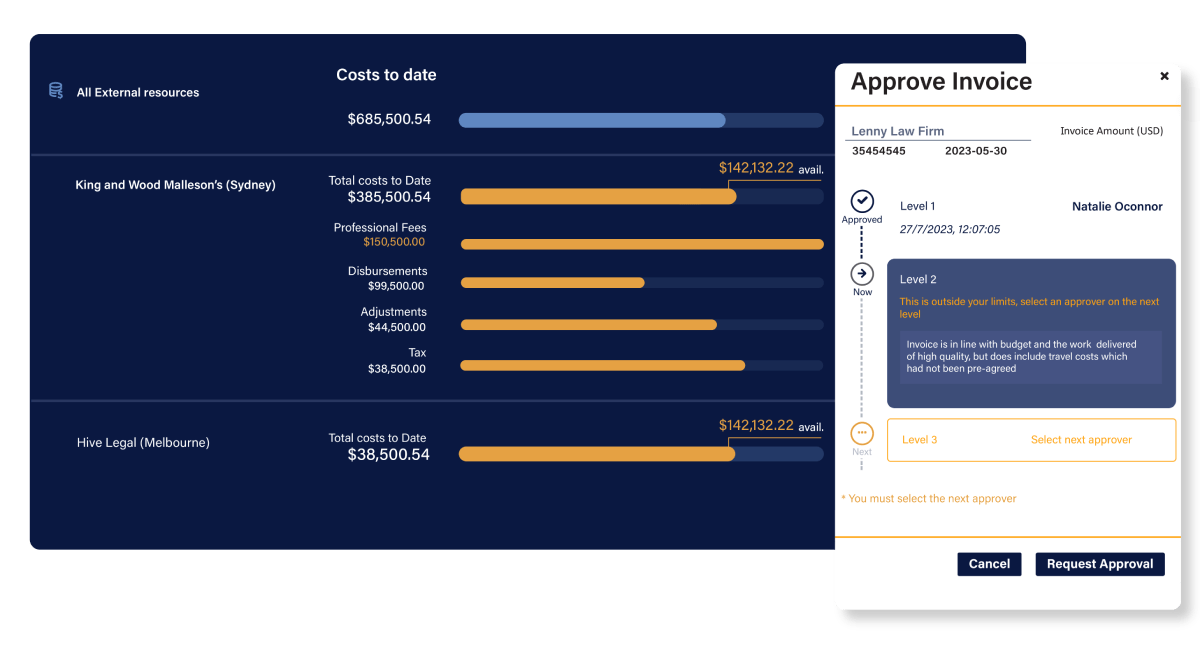
Receive, review and approve or reject invoices seamlessly
Automatically route approved invoices to your enterprise financial system
What is the best legal matter management software in 2026?
Comparison table
Tool
Tool Description
Best For
Pros
Cons
Xakia
Xakia runs legal matter management, intake, spend, and reporting from one platform built for in-house legal teams.
In-house legal teams seeking a comprehensive, modern matter management system
Fast implementation; excellent reporting; strong integrations; purpose-built for in-house teams
Designed for in-house use only, not for law firms
Checkbox.ai
Checkbox.ai centres on workflow automation, allowing legal teams to build self-service tools and automate repetitive, low-risk processes.
Legal operations teams focused on automating standardized processes
Strong workflow automation; good for high-volume tasks
Less robust for full matter management
Brightflag
Brightflag offers a spend-focused approach to matter management software, with a relatively simple interface.
Teams needing clear visibility into their budget
Useful visibility; solid reporting
Limited depth in automation and advanced features
Onit
Onit is an intricate solution, designed for large organizations with complex legal operations.
Large enterprises with sophisticated requirements
Highly configurable and highly scalable
Requires significant implementation time and investment
Ironclad
Ironclad is a matter management solution primarily specialising in contract management and document automation.
Teams struggling with contract backlog
Helpful contract lifecycle management tools
Less holistic approach around matter management
LawVu
LawVu offers an extensive platform which brings together document automation, collaboration, and reporting.
Larger-sized legal teams able to adopt complex software
Offers collaboration tools, reporting capability
Potentially difficult to integrate with pre-existing tech. Expensive
Clio
Clio is a well-known legal platform offering basic matter and document management primarily for law firms and smaller teams.
Law firms
Simple interface; good for small teams
Not designed for complex in-house environments
Which platform reigns supreme? Our verdict
Already adopted by many international household name brands, Xakia stands head and shoulders above its competitors for in-house teams looking to revolutionise their operations.
Because it was specifically designed for use by in-house teams, Xakia’s clean, intuitive interface is easily integrated and set up, which drives adoption. This, however, does not compromise its sophistication in data analysis and reporting, making it easier to demonstrate effectiveness and value.
Importantly, it is also scalable and cost-effective, with a transparent and competitive pricing scheme without any sneaky charges or hidden fees. If you are looking for the right legal matter management for your business - speak to Xakia today.
See Xakia's matter management software in action
Built for in-house legal teams. Track every matter, from intake to close.
Legal matter management is how an in-house team tracks every piece of legal work, from the first request to the final close: who's handling it, what's due, what it's costing, and where the documents live. Done right, it replaces a mess of email threads and spreadsheets with one place the whole Legal Department can see.
What is a legal matter management system used for?
A legal matter management system gives an in-house team one record for every matter: intake, assigned owner, deadlines, documents, and spend, instead of that information sitting in five different places. It's built so a legal leader can answer what the team is working on right now without chasing five people for an update.
What's the best matter management solution for an in-house legal team?
The best matter management solution is the one built for in-house teams specifically, not one adapted from law firm practice management or bolted onto a bigger enterprise procurement suite. Xakia's matter management software fills that gap: intake, spend, documents, and reporting in one platform, built for legal departments of five people or fifty.
Is matter management software only for law firms?
No. Law firms typically use practice management software built around billable hours and client files. In-house legal departments need something different: a system built around matters, deadlines, spend, and reporting to leadership. Xakia is built specifically for in-house teams, not law firms.
What should a legal department look for in matter management software?
A legal department should look for software that covers intake, document storage, spend tracking, and reporting in one system, that's simple enough for the whole team to actually use, and that a small legal team can set up itself without an IT project. Most platforms in this space were built for large legal departments first; a team of five has different needs than a team of fifty, and the software should not force one team to work like the other.
Jodie is an innovator, entrepreneur, and advocate of LegalTech. Her passion to give in-house counsel greater visibility and control to their legal operations is the driving force behind Xakia, an in-house legal matter management platform that is simple, powerful and affordable and services hundreds of legal teams - and thousands of lawyers - around the globe.
Not all legal document software is built for in-house teams. Our honest take on Checkbox, LawVu, Onit, Lawcadia and more — including why Xakia stands...