
Cancer Council Queensland saves 1-2 hours per lawyer per day with Xakia
Team : 3-person Legal Department (General Counsel, one lawyer, a paralegal / assistant company secretary), plus a graduate lawyer seconded one day a week. All part-time, hybrid.
Location : Queensland, Australia
Product used : Xakia legal matter and contract management

Industry
Not-for-profit charity
Key results
- - Time saved per lawyer - 1-2 hours per day
- - Time saved on handed-over matters - ~25%
- - Open matters managed at once - 50 to 100
- - Share of the team's work that is contracts - ~50%
Why Samantha made the switch
“Better visibility, better discipline, less chasing, and a clear trail of what we’ve been working on and how a matter has progressed.”

Samantha Lennox
General Counsel & Company Secretary,
Cancer Council Queensland
The challenge
Cancer Council Queensland is a not-for-profit charity, and people often ask Samantha Lennox why a charity needs a lawyer at all. The answer is that her role is an in-house corporate one, the same as in any for-profit business, with a few weird and wonderful extras thrown in. The organization runs community services, funds and conducts cancer research, and sits inside a national federation of state and territory cancer councils, each a separate legal entity. That mix throws up a lot of varied legal work..
Samantha has been with Cancer Council Queensland for 15 years, and the other lawyer on the team has been with her for about nine or ten. They know each other’s work and they trust each other. But three people, all part-time and hybrid, created a problem that familiarity couldn’t solve.
When one lawyer was in the office and the other wasn’t, picking up a matter mid-stream meant reconstructing it from email folders and SharePoint files. There was no quick way to see where something stood. For Samantha as the leader, there was no easy way to see what her team was working on or what the status was.
The intake side was just as rough. Requests came in from the business without complete instructions, which meant a lot of back-and-forth before any real work could start. The team had tried to build something in Microsoft Forms and found it difficult, because they don’t have IT skills in the legal team
“We would get a lot of requests in from the business that didn’t have fulsome instructions. We were trying to develop something in Microsoft Forms, but we found that difficult, because we don’t have IT skills in my team.”
Samantha Lennox
Then there was follow-through. At any one time the team might have 50 matters open across every part of the business. They’d take instructions, give the advice, and often hear nothing for six months. The matter would sit in an email folder or a SharePoint folder, and the team would leave it to the business to act. Six months later the finance team would ask what happened to a contract, and the team would have to try to piece that together from disparate records.
Contracts are about half of everything the team does, but storage was a maze. The legal team saved contracts by counterparty name. The business referred to them by project name. So, when finance asked “where’s the contract for such-and-such project?”, it was difficult for legalto connect the two. Novations made it worse: when a contract moved from one party to another, which folder did it belong in, the original party’s or the new one’s? Head agreements, statements of work, and variations were scattered with no way to link them together.
And underneath all of it, there was no reporting. Samantha had a gut feeling that contracts were about half the team’s work, but no way to measure it, monitor it, or prove it. Without data, the Legal Department couldn’t show leadership which parts of the business were generating the most legal work, or demonstrate its worth.

“Previously, we didn’t have any way of easily reporting what my team was doing and to prove our worth to the business.”
Samantha Lennox
The solution
1. Choosing Xakia
Samantha belongs to a national network of not-for-profit in-house lawyers who meet monthly to share resources and ideas. At least once a year, the conversation turns to what systems teams are using for legal matter management. That gave her a shortlist of providers her peers had already tested. She went out to the recommended names, sat through demos, and judged each on fit.
Functionality came first: intake, progress tracking, reporting, and dashboards. Pricing mattered enormously, because as a not-for-profit the team had no budget for any of it. Then came the security checks, which Xakia passed alongside the team’s internal IT requirements. A few other tools could have done the job on features, but were too expensive or fell short for one reason or another.
“Xakia was a standout... in the end, the decision was easy.”
Samantha Lennox
2. Handover without the archaeology
The team still checks in with each other over Teams every day. That hasn’t changed. What’s changed is the days when someone isn’t in the office. If Samantha does a bit of work on a matter to keep it moving, the other lawyer can see exactly what’s been done and pick it up the next day, with every document to hand. No digging through email files and SharePoint to reconstruct the story.
There’s a second payoff Samantha didn’t expect. Because similar matters are easy to pull together, the team can look at how it handled a comparable contract review in the past and reuse that thinking. Some work gets less complex, not more, once you can see the patterns.
3. Intake that triages itself
Internal clients now complete a set list of fields, so the team gets more detailed and complete instructions up front and less back-and-forth. The intake form also requires executive sign-off or knowledge of the matter, so the team knows the engagement was approved at the right level before anyone starts a pile of work that turns out not to be needed.
The biggest win, for Samantha, is triage. With 50 or even 100 things in progress at once, everybody thinks their request is urgent. Xakia makes them define what urgent actually means.
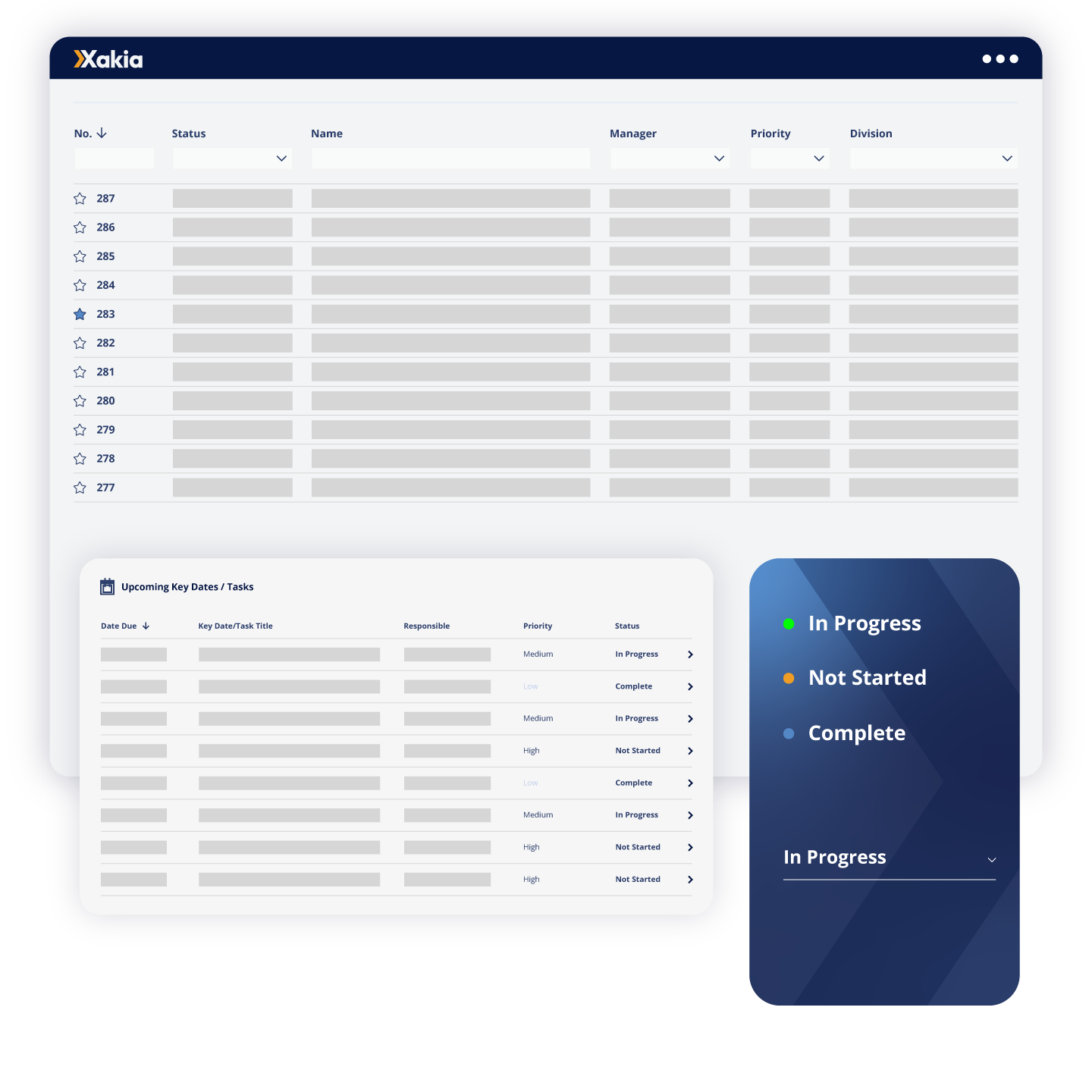
“Everybody thinks their request is urgent, but getting people to define urgent is difficult. Now, being able to sort by risk or strategic importance is really valuable.”
Samantha Lennox
4. One contract portfolio the whole business can find
Contracts used to live across two SharePoint databases: working files in one, final signed versions in another, kept apart so the approved copies wouldn’t get muddled with drafts. Now they live in Xakia, captured with the fields that matter: counterparty, project name, a brief description, commencement date, and value. Legal can search by counterparty. Finance can search by project name. The “we didn’t save it under that name” problem is gone.
Samantha’s other favorite is keeping a family of contracts together. A head agreement, its statements of work, and its variations all sit grouped so you can see how they relate.
5. Dashboards that prove the team’s worth
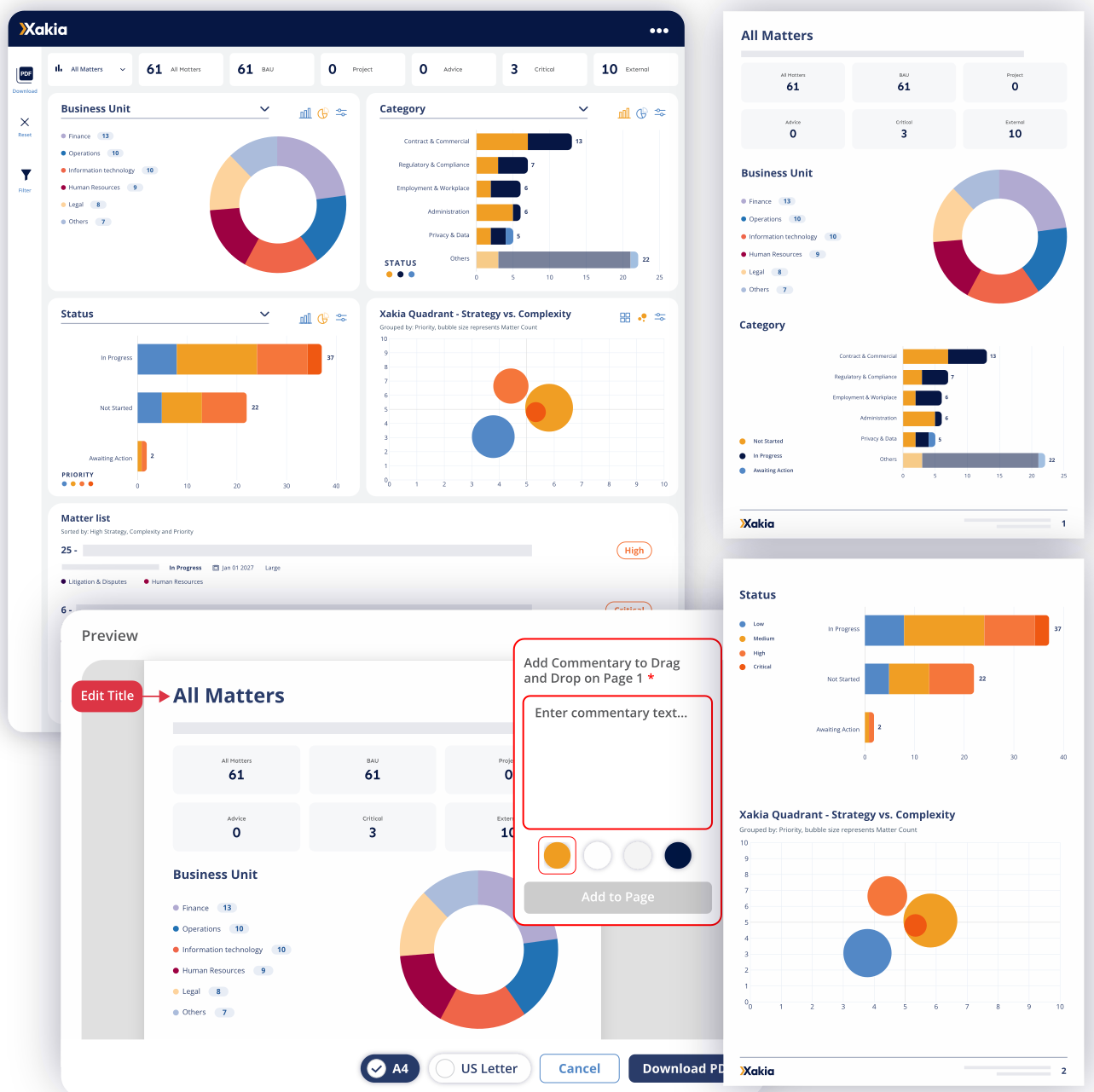
This is the part the team never had a version of before and reflects a major step up. Samantha now uses Xakia dashboards across a few forums. Every team in the business sends a monthly update to all staff, so she pulls a brief executive summary with headline numbers into hers, which is especially useful for managers who want to understand the legal work their department is generating. In executive team meetings she shares what her team is working on and shows contract dashboards to department heads, flagging renewals and trends coming up for their area. It’s a chance to check the execs are getting what they need from their contract administrators and are across the milestones that matter.
The reporting also tells her, over time, which internal departments create the most work, so she can take that back to the executive team and the CEO with the reasons behind it.
“In the ‘before Xakia’ world, if you’ve got a novation of a contract from one party to another, which folder do you save it in? But now we don’t have to worry about that because all contracts are linked together as a family in Xakia.”
Samantha Lennox
Results
1. 1-2 hours back, per lawyer, per day
whole team saves at least one to two hours a day each, hers and her colleague’s. For a two-lawyer team working part-time, that compounds fast.
On handover specifically, her gut says about a 25% time saving on the matters that get passed between them, roughly half an hour on any given day.
2. Less chasing, more follow-through
After the team gives advice, it sets a date to follow up, to check the advice was understood or implemented, or to see whether a contract has been signed. So when finance asks about a contract six months later, the answer is much easier to find. The team can say what stage it’s at, confirm if it was signed, and confirm whether legal holds a copy.
3. Pro bono firm tracking, an unexpected win
Nearly all of Cancer Council Queensland’s external legal advice comes from law firms working pro bono, which is remarkable. The team still needs to know which firms it uses and how often, both to give them the recognition they deserve and to make end-of-financial-year work easier. At audit time, Samantha can quickly pull the list of firms to contact for solicitors’ confirmation letters.

Book a free demo
If your legal team is spending more time managing the chaos than managing the work, book a free demo and see what better visibility looks like for a team your size.
“I’m so used to working with Xakia now that I’ve forgotten how clunky and difficult it was before.”
Samantha Lennox