ELM platforms promise to do everything. Here's how to figure out which ones deliver for your team's size and budget.
The term "Enterprise Legal Management" gets thrown around so much it doesn't mean anything anymore. One vendor says it includes matter management. Another says you need CLM. A third insists that spend management is the foundation. They can't all be right, which means you need to figure out what ELM means for your specific Legal Department.
I'm going to give you the straight version. ELM is a category of software that handles the operational side of running a Legal Department. That includes intake, matter management, document management, contract lifecycle management, spend tracking, and reporting. Every vendor in this space claims to do all of it. Some do. Most do one or two things really well and bolt on the rest.
The difference between picking the right platform and picking the wrong one? It's probably a year of your team's time and a six-figure investment. So, let's talk about this carefully.

What ELM Means
ELM platforms are built to solve the operational problems that grow inside Legal Departments. You start with a couple of lawyers managing everything in email and spreadsheets. That works for about thirty seconds. Then you add people. Suddenly you need to track what's in progress, whether you're hitting client deadlines, which external counsel to use, what contracts are signed. That's where ELM comes in.
What ELM is not: It's not going to replace your judgment. It won't make bad lawyers good. It won't fix broken relationships with the business. What it will do is give you visibility into what you're doing and help you do it more efficiently and effectively.
Core ELM Capabilities
Matter Management: This is the center of the wheel. You need a system that tracks every legal matter from intake through completion. What sort of work is it? Who requested it? What's the deadline? Which external counsel is involved? Is it on track? Matter management ties everything together.
Intake: Standardize the processes for receiving work, with a simple, clear process for your business requesters, providing complete information and instructions to the Legal Department the first time, allowing you to receive, triage, route and resolve issues automatically and/or efficiently and effectively. This process and information should be automatically linked to analytics for issue spotting and further process refinement.
Document Management: Your team generates and receives hundreds of documents every month. Emails, drafts, final agreements, correspondence, opinions. You need to know where they are, who has access, what's confidential, what's discoverable. A good document management system is integrated with your matter management so that documents automatically attach to the right matter, stay organized and can be efficiently found / retrieved when you need them.
Contract Lifecycle Management (CLM): If your business signs contracts, you need to manage them through their entire lifecycle. That means capturing what's signed, storing them where people can find them, understanding what obligations you have committed to, and managing renewals before they surprise you. CLM is critical if you have lots of vendor agreements or customer contracts.
Spend Management: How much are you spending on external counsel? Are you on budget? Which outside firms are getting most of the work? Are you getting competitive rates? Spend management tools track legal expenses and give you visibility into where money goes.
Reporting and Analytics: You need to see patterns in your data. How many matters per month? How long do different types of matters take to close? Which client consumes the most resources? What's your matter cost per type? Reporting is how you demonstrate value and identify where processes need improvement.
.svg)
Comparing ELM Platforms
Xakia. Xakia was built for Legal Departments of two to twenty, with a focus on simple-to-use but powerful functionality. Ironically, the first buyer of Xakia software was an in-house legal team of fifty lawyers who also valued the “simple but powerful” approach, and today Xakia is used by a wide range of very large teams up to 200, reflecting its enterprise scale security and functionality, accessible to smaller teams too.
The platform integrates matter management, intake, documents, spend, contracts and reporting. For document management, you can choose from native document capabilities, Outlook and Gmail filing, or integrations with NetDocuments, iManage, or SharePoint. Functionality includes version control, document creation from templates, e-signature support, and confidentiality controls. Everything is encrypted. The big difference with Xakia is speed of implementation. Days, not months. If you're a mid-size legal team trying to move fast to improve your ways of working, this software is literally built for you.
Mitratech. Mitratech is purpose-built for large enterprise Legal Departments. If you have more than fifty lawyers, lots of international operations, complex billing requirements, and enterprise security needs, Mitratech can handle it. The tradeoff is complexity and implementation time. You are looking at a multi-month project with dedicated resources.
LegalTracker / Thomson Reuters. Another incumbent, LegalTracker and Thomson Reuters products have a strong user base in the in-house legal market. Thomson Reuters has many tools to offer, but everything comes with a hefty price tag and a long implementation timeline. If your company is paying Thomson Reuters for other services, the integration argument is tempting.
SimpleLegal. SimpleLegal is spend management first. If your primary problem is understanding and controlling legal spend, they are excellent. But they are narrower than a full ELM platform. You will still need matter management, document management, and reporting from somewhere else.
Onit. Onit is modular. You can buy different components and assemble them into your own ELM system, requiring lengthy configuration and customization projects that require both Legal and IT team investments. This project typically runs well at a multiple of six-figures, and will take a similar chunk of time.
The Real Decision Framework
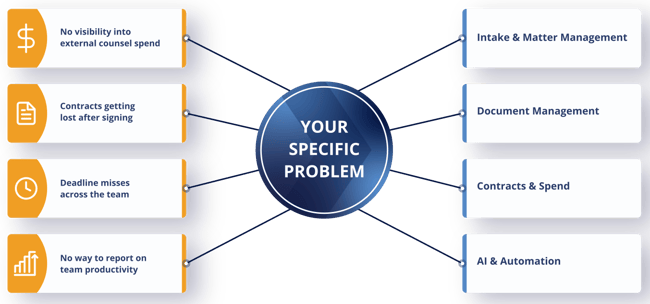
Here's what I recommend. Stop thinking about ELM as a category. Start thinking about your specific problems. Maybe your biggest issue is that contracts get signed and then nobody knows where they are. That points you toward a CLM system. Maybe it's that your external counsel spend is out of control. That points toward spend management. Maybe it's that you have no visibility into what your team is working on. That points toward matter management.
The tool that solves your problem today is likely to be the right tool, but keep in mind that your Legal Department needs will grow over time, so think long term. Solving one problem today is good. Having an eye on the broader problems that needs solving will help you to procure the right tool for your team of the future.
Critical Questions to Ask
Implementation Reality Check
Here's what kills most ELM implementations. Overscoping. You get excited about the product. You start mapping every possible use case. You want to include every person in the organization. You want to customize everything. Now you are eighteen months in and still not live. This is far more common than you might think. At the time of writing, we have two clients who are implementing a CLM – both are in year four of their respective projects and still not live.
Here's the better approach. Start with one use case. Get that working well. Get adoption. Prove value. Then expand. A faster win beats a perfect solution that never ships.
When you are evaluating ELM vendors, ask about their implementation methodology. Do they have a rapid deployment option? Can you go live in weeks, not months? How much customization is necessary versus nice-to-have? Ask about their onboarding process. Who owns the success of the implementation? Is it a partnership or are they handing you off to third-party consultants who charge by the hour? These details matter because they affect both timeline and cost.
Start with Your Problem, Not the Category
The teams that get the most value from legal technology are the ones that started with a specific, measurable problem. Not enough visibility into external counsel spend. Contracts getting lost. Deadline misses. No way to report on team productivity. They picked a tool that solved that problem, implemented it fast, and then added other capabilities later.
Be specific about what you are trying to accomplish. Get that working. Then expand from there. One successful deployment leads to the next. Your team gains confidence. They suggest new use cases. That organic growth is how you build a successful legal tech program. Choose a platform that allows you to foster further legal technology adoption to suit the growing maturity of your Legal Department. That includes AI features that you might not be ready for today if you’re just putting the foundational pieces like intake, matter management and document management in place, but you want to know that they are available as you move through this process.
The Security and Compliance Piece
Before you commit to any platform, understand their security and compliance posture. You are storing sensitive information. Client data. Contracts. Correspondence. That needs to be protected.
Any serious ELM vendor should be ISO 27001 certified, SOC 2 Type 2, and HIPAA compliant. They should be GDPR compliant. They should have encryption in transit and at rest. They should have data backup and disaster recovery. They should give you clear information about where your data lives and who has access to it.
If a vendor gets vague when you ask about security, that is your answer. Move on.
Common ELM Myths
Myth One: You need the biggest platform with the biggest reputation to make a ‘safe’ choice. False. You need a platform that solves your problems well, both today and in the future, not one that is a legacy provider without flexibility to grow in a rapidly changing technology landscape. Procuring based on big software names is not a strategy for addressing your needs today or in the future.
Myth Two: Implementation takes months because legal is complex. False. Legal is complex, but good, modern software handles that complexity without forcing you to customize everything. If a vendor is telling you months of implementation is standard, question that.
Myth Three: You need to fix your processes first, then implement software. Backwards. Understand your processes, yes, but software will help you to fix the problems and also to discover what more need fixing – because this is a long journey, not a single destination. Keep refining.
Myth Four: ELM software will force everyone to work the same way. Good software should be flexible enough to adapt to how your team works, not force your team to adapt to the software.
Moving Forward
Enterprise Legal Management software is useful. But it is only useful if it solves your problems today, has flexibility for your Legal Department growth tomorrow, and your team uses it. The best ELM platform in the world is worthless if it takes a year to implement and your team hates it.
So, start small. Pick one problem. Find a tool that solves it well. Get it implemented fast. Prove the value. Then expand into the next problem. You will get better results, your team will use it, and you will spend less money.
The legal tech market is crowded. But if you use the evaluation framework I have laid out here, you will find the right platform for your team. Start with your problem. Focus on implementation speed. Foster adoption by making it a delight to use. Then move forward.
What Success Looks Like

When you have the right ELM platform, your team spends less time managing information and more time on actual legal work. Matters flow through your system smoothly. Contracts can be found when you need them. You know exactly what you are spending on outside counsel. Your reporting is automated.
Your team does not resent the system. They use it because it makes their job easier. Adoption is natural, not forced. That is when you know you made the right choice.
If you are in the market for an ELM platform, start with your problem. Pick the vendor who solves it best. Get it live quickly. Then build from there. You will be successful.
Want to see how a modern ELM platform works?
Book a free demo at xakiatech.com/book-a-demo to see matter management and document management built together.